
Are Goldendoodles Hypoallergenic? What the Research Actually Says
No. No dog breed is truly hypoallergenic and Goldendoodles are no exception. A 2012 study in the Journal of Allergy and Clinical Immunology found Poodles carried the highest levels of the main dog allergen of any breed tested. What varies is not the breed. It is the individual dog.
That answer disappoints people, so most breeder soften it. This guide will not.
If someone in your house reacts to dogs and you are about to spend $3,000 on a puppy, you deserve the actual research rather than a sales page. The good news is that the picture is more useful than a flat no. There are real reasons some allergy sufferers live happily with a Goldendoodle, and there are specific things you can test before you commit.
What Actually Causes a Dog Allergy (It Is Not the Hair)
Almost everyone gets this wrong, including plenty of breeders.
You are not allergic to dog hair. You are allergic to proteins the dog produces. Those proteins live in dander (dead skin flakes), saliva and urine. Hair is just the delivery truck. It carries dander around your house and drops it on your sofa.
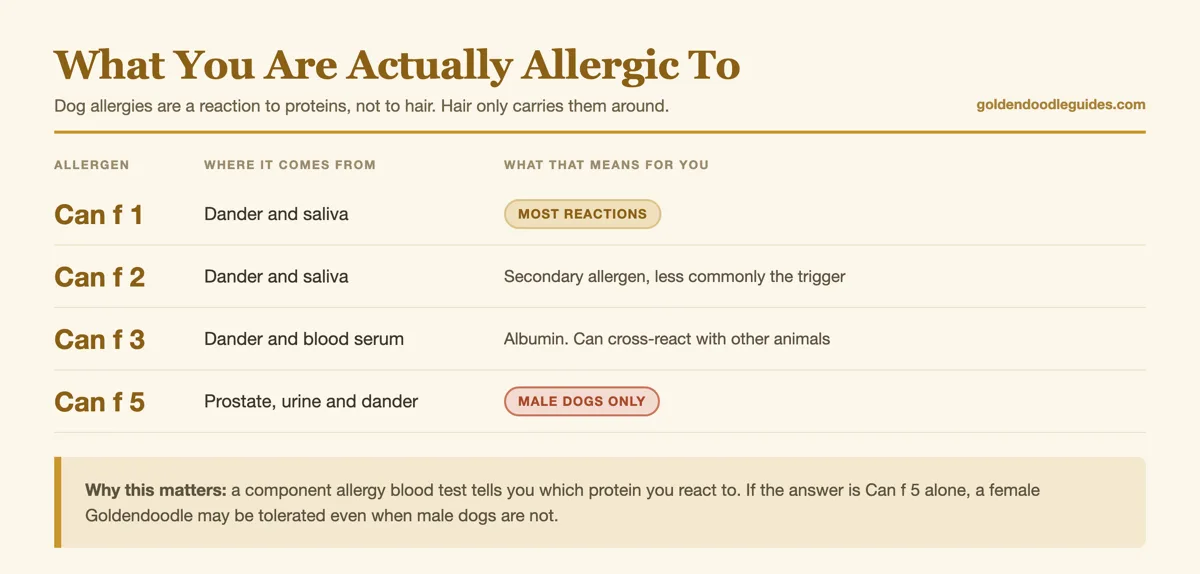
Dogs produce several of these proteins. The ones that matter have names:
- Can f 1 is the big one. It is found in dander and saliva, and it accounts for the majority of dog-allergic reactions.
- Can f 2 and Can f 3 show up in dander and serum.
- Can f 5 is produced in the prostate. Only male dogs make it. Hold onto that, because it changes things for some people.
This is why “low-shedding” and “low-allergen” are not the same sentence. A dog that sheds less spreads less hair. It does not necessarily produce less protein.
What the Research Says About Hypoallergenic Dogs
Here is the study that should be in every one of these articles and almost never is.
In 2012, researchers at Utrecht University measured Can f 1 levels in the hair of so-called hypoallergenic breeds, including Poodles, Labradoodles, Spanish Water Dogs and Airedale Terriers, and compared them to Labrador Retrievers and a mixed control group. They also measured allergen levels in the owners’ homes. The results were published in the Journal of Allergy and Clinical Immunology.
Two findings, both uncomfortable for the doodle industry.
First, the “hypoallergenic” breeds had more allergen in their coats, not less. Poodles came out highest of all. Labradors came out lowest.
Second, when researchers measured the homes, the differences vanished. There was no meaningful gap in allergen levels between houses with a Poodle and houses with a Labrador.
The authors’ conclusion was blunt: there is no evidence to describe any dog breed as hypoallergenic.
Why Do Some Allergy Sufferers Swear by Doodles?
This is where honest reporting gets interesting.
The study also found something people skip over: allergen levels varied enormously between individual dogs of the same breed. Two Poodles could sit at opposite ends of the range. The breed average told you very little about the specific animal.
That matches what allergy families actually report. Some react badly to one Goldendoodle and barely at all to another from the same breeder. Not because one is a better generation, but because dogs are individuals.
There is also a mechanical argument that the study did not test directly. A curly coat holds shed hair and dander inside the coat instead of dropping it on the floor. The allergen is still there. It is just parked in the dog rather than circulating through your living room until the next groom. Whether that translates into fewer symptoms is not settled science, and you should treat it as a plausible mechanism rather than a proven benefit.
So Are Goldendoodles Good for People With Allergies?
For mild allergies, often yes. For severe allergies or asthma, proceed with real caution.
The honest framing is risk reduction, not risk elimination. A low-shedding Goldendoodle with a curly, well-maintained coat will probably put less hair and dander into your home than a Golden Retriever. That is a genuine difference and it matters to a lot of families.
But it is not a guarantee, and no breeder can give you one. Anyone who promises a hypoallergenic puppy is either uninformed or selling.
If the allergy in your house involves asthma, emergency visits, or reactions severe enough to need medication, a dog of any breed is a serious decision. Talk to a board-certified allergist before you talk to a breeder.
Which Goldendoodle Is Best for Allergy Sufferers?
The standard advice is “get an F1B.” That advice is out of date.
Generation labels describe ancestry percentages. An F1B is 75% Poodle, an F1BB is 87.5%, a multigen sits somewhere between 60% and 85%. More Poodle shifts the odds toward a curly, low-shedding coat. We break the whole system down in our guide to Goldendoodle generations.
But odds are not outcomes. A single gene called RSPO2 controls furnishings, the beard and eyebrows that give doodles their look and go along with a low-shedding coat. A puppy that inherits no copy of the furnished version has what breeders call an improper coat, and it sheds like a Golden Retriever.
Two furnished parents can produce an unfurnished puppy. It happens in F1B litters. It happens in multigen litters. The label on the pedigree will not warn you.
Ask for Coat Testing, Not a Generation
The question that actually protects you is this:
“Have both parents been DNA tested for RSPO2 furnishings, and can you send me the results?”
A breeder who tests can tell you before the puppies are born what coats the litter will carry. A breeder who does not test is guessing, whatever letters are on the paperwork. An F1B from an untested line is a worse bet than a tested multigen, and it usually costs more.
Coat Type Matters More Than Generation
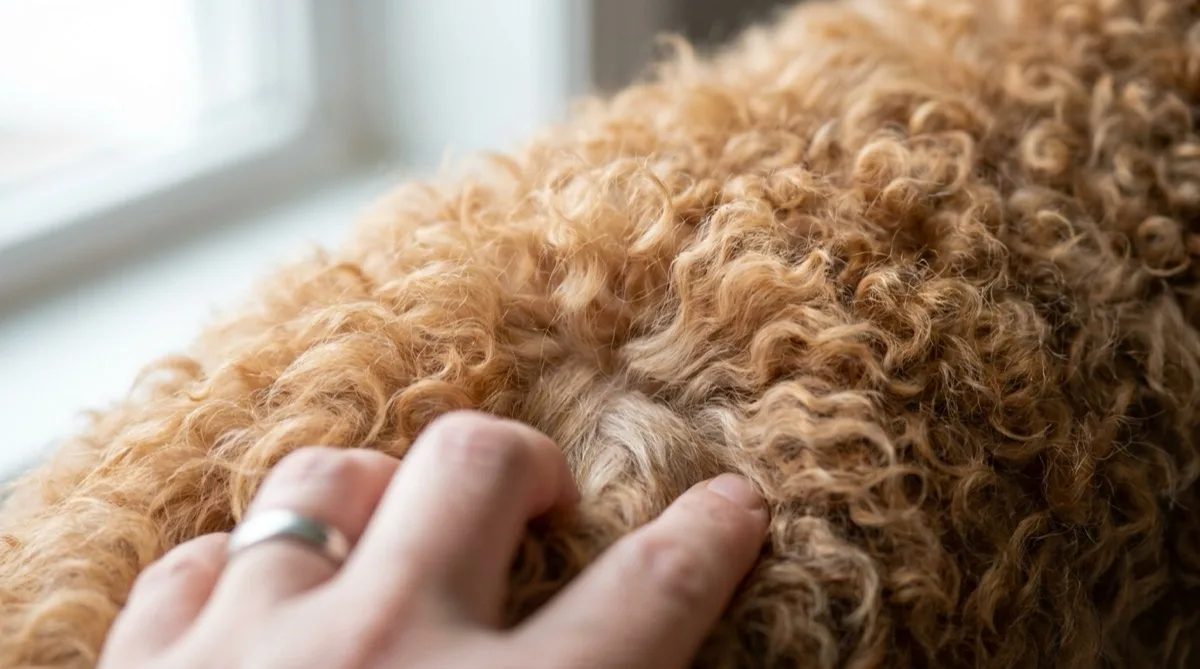
Once the puppy exists, the coat in front of you tells you more than its pedigree does.
- Curly. Tightest coat, holds the most shed hair, drops the least. Best odds for allergy households. Needs brushing three to four times a week and professional grooming every six to eight weeks.
- Wavy or fleece. The most common Goldendoodle coat. Sheds lightly. Workable for mild allergies, less predictable.
- Straight or flat. Usually an unfurnished coat. Sheds the most. Not a good choice if allergies are the reason you chose a doodle.
You can see coat type reasonably well by eight weeks, and clearly by six months. If you are buying for allergy reasons, meet the puppy in person. Do not buy from photographs and a promise.
Male or Female: The Difference Nobody Explains
Competitor articles raise this question and then give you nothing. There is an actual answer, and for a minority of people it is the answer that matters most.
Remember Can f 5, the allergen produced in the prostate. Only male dogs make it. Female dogs produce none, and neutered males produce substantially less.
Some people are sensitized to Can f 5 and nothing else. In controlled provocation testing, children who were mono-sensitized to Can f 5 reacted to male dog extract and tolerated female dog extract. Thermo Fisher’s allergen reference on Can f 5 documents the same pattern.
The practical version: if you react to dogs, a component-resolved allergy blood test can tell you which dog protein you react to. If the answer is Can f 5 alone, a female Goldendoodle may be genuinely fine for you, regardless of generation or coat.
Almost nobody in the doodle world mentions this. Ask your allergist for component testing before you rule out dogs entirely.
How to Test Before You Commit

A puppy is a ten to fifteen year decision. Spend two weeks testing first.
- See an allergist and ask for component testing. Find out whether you react to Can f 1, Can f 5, or something else. This one step changes the whole plan.
- Spend two hours with the parent dogs. Not ten minutes at the door. Sit in the room, touch the dogs, let the exposure build.
- Go back a second time, on a different day. One good visit can be luck or antihistamines.
- Ask to take home a blanket the litter has slept on. Keep it in your bedroom for two nights. This is the closest thing to a real trial run, and good breeders say yes without hesitating.
- Agree on what happens if it fails. A reputable breeder will take a puppy back. Get that in writing before you pay.
Living With a Goldendoodle When You Have Allergies
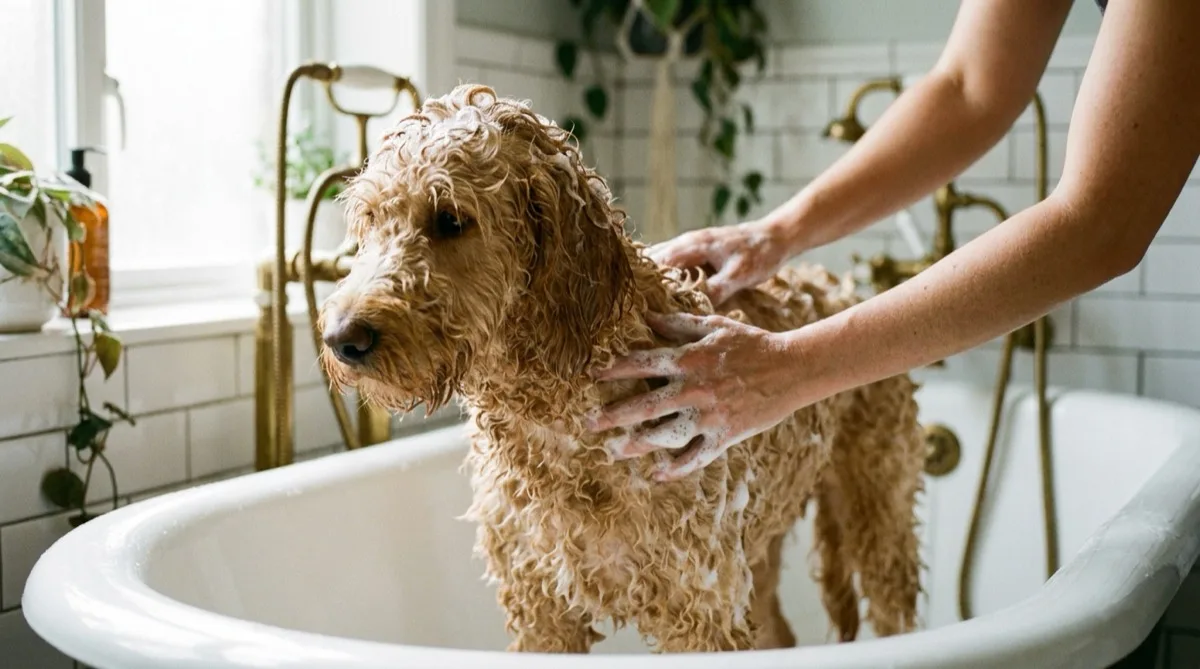
If you go ahead, management does more work than genetics ever will.
Bathing
Research published in the Journal of Allergy and Clinical Immunology found that bathing twice a week can cut Can f 1 on a dog’s skin and coat by up to 84%. The catch is that levels rebound within two to three days, so occasional baths accomplish very little. It has to be routine or it is not worth doing.
Twice-weekly bathing can dry out a doodle’s skin, so use a gentle, soap-free shampoo and talk to your groomer about what suits the coat.
Brushing and Grooming
Brush three to four times a week, ideally outdoors or in a room the allergic person does not use. Professional grooming every six to eight weeks at $65 to $120 a session. Skipping grooming does not just cost you a matted dog. It leaves more dander sitting in the coat.
The House
- HEPA air purifier in the bedroom, running continuously
- Vacuum with a HEPA filter, high-traffic areas daily
- Wash bedding weekly at 130°F or hotter
- Keep the dog out of the allergic person’s bedroom, permanently and from day one
- Hard floors beat carpet by a wide margin
The bedroom rule is the one families break and then regret. You spend a third of your life in that room. Protect it.
Treating the Allergy Itself
Managing the dog only goes so far. Antihistamines, nasal steroids and immunotherapy (allergy shots or sublingual drops) treat the actual problem. Many people who live comfortably with dogs are on immunotherapy, not a special breed. The Asthma and Allergy Foundation of America outlines the treatment options in plain language. The National Institute of Environmental Health Sciences has a plain-language overview of pet allergens worth reading before your appointment.
The Downside Nobody Mentions
Three things get left out of the brochure.
Grooming is not optional and it is not cheap. The coat that traps allergens also mats. Budget $600 to $1,000 a year, every year, for the life of the dog. Families who buy a curly doodle for allergy reasons and then cannot afford grooming end up with a shaved dog, which defeats the purpose.
Saliva is a separate problem. If your reaction is triggered by licking rather than dander, coat type is irrelevant. A Goldendoodle will lick you exactly as much as any other dog.
Rehoming rates are real. A meaningful number of doodles are given up when a family discovers the allergy did not improve, or the grooming commitment was more than they expected. Testing properly before you buy protects the dog as much as it protects you.
Goldendoodle vs Other Low-Shedding Breeds
If allergies are the deciding factor, a Goldendoodle is one option among several.
Standard Poodle. The most predictable coat of any of them, because there is no crossbreeding lottery. Remember that Poodles measured highest for Can f 1 in coat samples, which underlines that predictable is not the same as allergen-free.
Labradoodle. Very similar profile with a slightly different temperament. Our Labradoodle vs Goldendoodle comparison covers the practical differences.
Australian Labradoodle. A separate multigenerational breed, so the coat range is narrower and the outcome more predictable. Our Australian Labradoodle vs Goldendoodle comparison covers what that costs.
Cavapoo. Much smaller at 9 to 25 pounds, with proportionally more Poodle. Our Cavapoo vs Goldendoodle comparison covers the size and health differences.
Portuguese Water Dog, Bichon Frise, Schnauzer. All low-shedding purebreds with established coat standards, which means fewer surprises than a first-generation cross.
If you are weighing a doodle against the parent breed, our Goldendoodle vs Golden Retriever guide lays out the shedding difference in detail.
Frequently Asked Questions
What to Do Before You Bring One Home
Strip away the marketing and the checklist is short.
Get component allergy testing so you know which protein you react to. Ask every breeder for RSPO2 furnishings results on both parents. Visit the parent dogs twice. Take a blanket home for two nights. Agree in writing what happens if it does not work out.
Do those five things and you will know more about your odds than any article can tell you, including this one.
And be honest with yourself about the grooming. The curly coat is the whole reason a Goldendoodle might work for your household, and that coat needs brushing several times a week for the next decade. If that is realistic, a Goldendoodle can be a very good dog for an allergy family. If it is not, no generation label will save you.
Still deciding between generations? Start with our Goldendoodle generations guide, or the F1 vs F1B breakdown.
This article is for general information and is not medical advice. If you or a family member has a dog allergy, speak to a board-certified allergist before bringing a dog into your home.
