Australian Labradoodle vs Goldendoodle: What You Are Really Paying For
An Australian Labradoodle is a developed breed with a written standard, a registry behind it and health testing the breeder has to sign up to. A Goldendoodle is a cross between two purebred dogs, repeated litter after litter, with nothing governing it.
Almost every practical difference comes back to that. You pay more for the Australian Labradoodle because you know in advance what the adult dog will look like, weigh and shed. You pay less for the Goldendoodle because some of that is left to chance.
Whether the extra $1,000 is worth it depends on how much surprise you can live with.
Australian Labradoodle vs Goldendoodle: Origins and Breed Development
Is an Australian Labradoodle Just a Labradoodle From Australia?
No, and this catches out more buyers than anything else in the comparison. A Labradoodle is a Labrador Retriever crossed with a Poodle, wherever it was born. An Australian Labradoodle is a separate breed, developed in Australia from the 1980s onward using six foundation breeds rather than two, and bred to a standard ever since.
A Labradoodle born in Melbourne is still a Labradoodle. The word Australian describes the breeding program, not the passport, and plenty of sellers blur that line on purpose.
The Six Breeds Behind an Australian Labradoodle
Six, added deliberately over decades to fix specific problems:
- Labrador Retriever
- Poodle, in all three sizes
- English Cocker Spaniel
- American Cocker Spaniel
- Irish Water Spaniel
- Curly-Coated Retriever
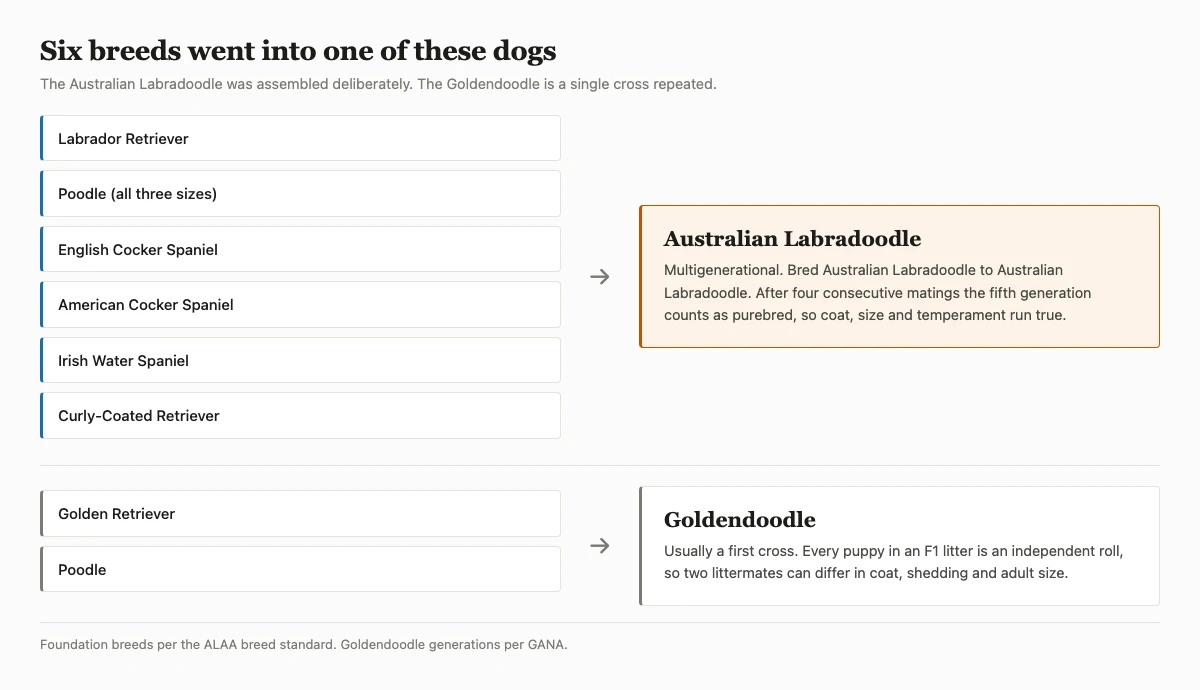
The spaniel and water dog lines went in mainly for coat consistency and temperament. What came out is a dog that breeds true, meaning a puppy resembles its parents rather than rolling the dice between them.
A Goldendoodle is a Golden Retriever crossed with a Poodle. Two breeds, and in most litters only one generation of mixing. Our guide to Goldendoodle generations covers what F1, F1B and F2 actually mean for the puppy you take home.
Why a Goldendoodle Litter Is Less Predictable
Australian Labradoodles are bred Australian Labradoodle to Australian Labradoodle. The ALAA breed standard sets out that after four consecutive multigenerational matings the fifth generation counts as purebred. Traits have had decades to settle, so a litter looks and behaves broadly like the parents in front of you.
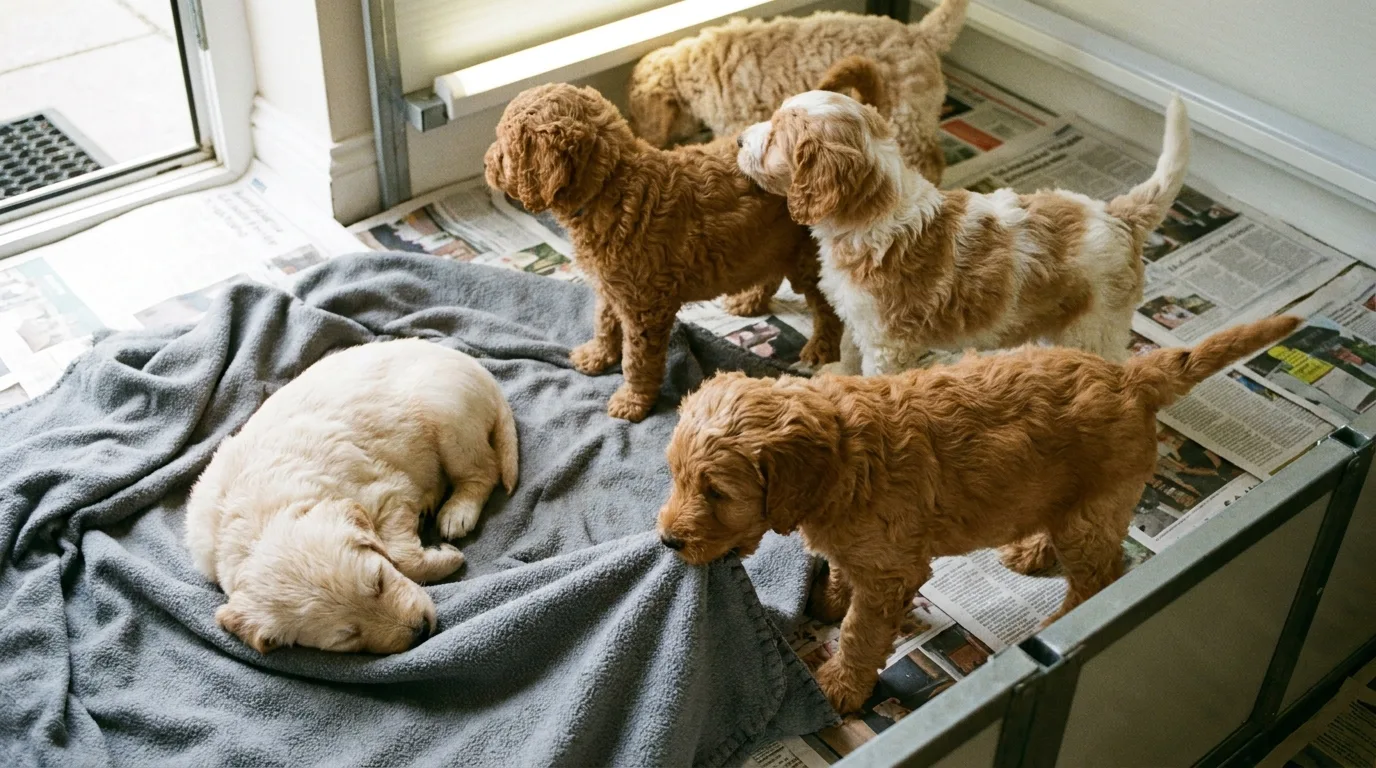
An F1 Goldendoodle is a first cross, and genetically every puppy in that litter is an independent roll. One inherits a Golden Retriever coat and sheds heavily. Its littermate inherits a tight Poodle curl. Same parents, same box, two different dogs.
This is why F1 vs F1B Goldendoodle matters so much on the Goldendoodle side. Backcrossing to a Poodle narrows the range of outcomes without closing it.
If you need to know the adult coat, size and shedding before you commit, the Australian Labradoodle gives you a more honest answer.
Australian Labradoodle vs Goldendoodle Lifespan and Health Issues
Health Testing Each Registry Requires
Both breeds have an association and both require testing from member breeders, so the interesting part is how tightly membership is tied to the breed. The ALAA health testing program calls for hip and elbow evaluations, annual CAER eye exams, and DNA testing for progressive retinal atrophy and exercise induced collapse. Breeders holding a Gold Paw retest every breeding dog every 18 months to keep it.
Because the registry defines what the breed is, a dog without ALAA or comparable registration is not really an Australian Labradoodle at all.
The Goldendoodle Association of North America also requires health clearances from member breeders and keeps a lineage database. Membership is voluntary though, and most people selling Goldendoodles are not members. Anybody can cross a Golden with a Poodle and use the name.
Ask for the same documents either way: Orthopedic Foundation for Animals hip, elbow, cardiac and eye clearances on both parents, plus DNA panels suited to the parent breeds. On the Goldendoodle side add GR-PRA1 and Ichthyosis, both of which come down the Golden Retriever line.
Lifespan by Size
Published lifespans overlap, but they hide a size effect. Smaller dogs live longer, and the Australian Labradoodle is capped at a size the Goldendoodle regularly passes.
| Australian Labradoodle | Goldendoodle | |
|---|---|---|
| Miniature | 13 to 16 years | 13 to 16 years |
| Medium | 12 to 15 years | 12 to 15 years |
| Standard | 12 to 14 years | 10 to 14 years |
| Practical average | 13 years | 12 years |
The inherited conditions differ because the foundation breeds differ. Neither list is a reason to rule a breed out, but both are a checklist for the conversation with the breeder.
Inherited Conditions by Parent Line
| Line | Australian Labradoodle | Goldendoodle |
|---|---|---|
| Labrador or Golden | Hip and elbow dysplasia, exercise induced collapse | Hip and elbow dysplasia, cancer, subvalvular aortic stenosis |
| Poodle | Addison disease, progressive retinal atrophy | Addison disease, progressive retinal atrophy, bloat in standards |
| Spaniel and water dog | Chronic ear infections, eye conditions | Not applicable |
| DNA tests to ask for | prcd-PRA, EIC | GR-PRA1, prcd-PRA, Ichthyosis |
Cancer is where they part company. Golden Retrievers carry an unusually high lifetime rate, documented across more than 3,000 dogs in the Golden Retriever Lifetime Study, where around 60 percent of enrolled dogs have been affected. Crossing with a Poodle lowers that without removing it, and Australian Labradoodles have no comparable burden in their foundation stock.
Ear trouble runs the other way. Three of the six Australian Labradoodle foundation breeds are drop eared water dogs, so chronic ear infections are common enough that weekly checks belong in the routine.
Australian Labradoodle vs Goldendoodle Size and Appearance
Size Comparison
The two breeds use almost identical size bands, which surprises people who assume the Goldendoodle is simply the bigger dog. Through the middle of the range they are close to interchangeable.
| Size class | Australian Labradoodle | Goldendoodle |
|---|---|---|
| Petite | Not recognized | Under 14 inches, under 25 lb |
| Miniature | 14 to 16 inches, max 17 | 14 to 17 inches, 26 to 35 lb |
| Medium | 17 to 20 inches, max 21 | 17 to 21 inches, 36 to 50 lb |
| Standard | 21 to 24 inches, max 25 | Over 21 inches, 51 lb and up |
| Overall weight | 15 to 65 pounds | 10 to 90 pounds |
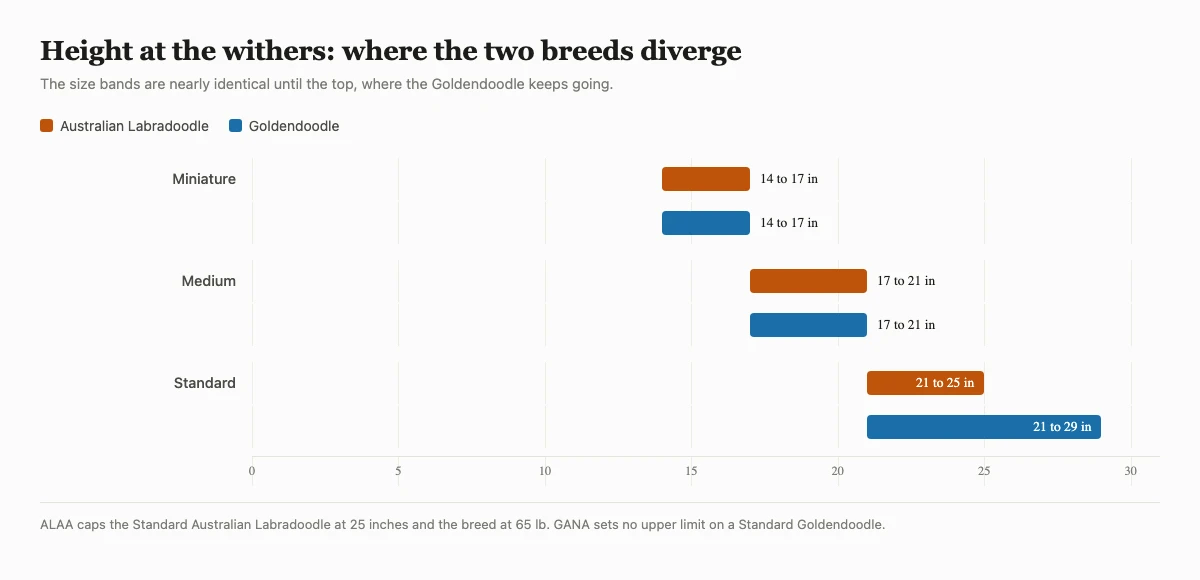
They diverge at the top. The ALAA standard caps a Standard Australian Labradoodle at 25 inches and the breed at 65 pounds, while GANA sets no upper limit on a Standard Goldendoodle and 80 to 90 pound adults are common.
So if you want a genuinely large dog, only one of these reliably produces one.
Body and Face Shape
Stand two dogs of the same height side by side and the outline gives them away. The ALAA standard asks for a square, compact frame on a medium boned body, neither heavyset nor overly fine. GANA describes the Goldendoodle as slightly longer in back than it is tall at the withers. Square against slightly rectangular is the clearest difference once you know to look for it.
| Feature | Australian Labradoodle | Goldendoodle |
|---|---|---|
| Body proportion | Square and compact | Slightly longer in back than tall |
| Muzzle | Foreface shorter than the skull | Straight, closer to a Golden Retriever |
| Eyes | Large, expressive, slightly rounded | Oval, moderately wide set |
| Ears | Set slightly above eye level, lying flat | Set roughly even with the eye, close to the cheek |
A standard describes the target rather than the dog in the pen. A multigenerational Australian Labradoodle lands close to it. A first cross Goldendoodle can sit anywhere between a Golden Retriever and a Poodle, so read the GANA description as the middle of a wide range.
Coat Types
The ALAA recognizes two coats and no others. Fleece is soft and falls either wavy or in loose spirals. Wool resembles lamb fleece and parts to the skin. Both are single coated and stay under four inches.
GANA approves three: curly, wavy and straight. That third one is the difference. A straight coat is a legitimate Goldendoodle coat with no equivalent on the Australian Labradoodle side, and it is the one that sheds.
Colors and Markings
Color is where a defined breed and an open cross separate most clearly. The ALAA recognizes sixteen colors, sorted into two groups by pigment.
| Black pigment | Chocolate pigment |
|---|---|
| Chalk | Caramel Ice |
| Cream | Caramel Cream |
| Apricot | Caramel |
| Gold | Caramel Red |
| Red | Chocolate |
| Black | Lavender |
| Blue | Café |
| Silver | Parchment |
Pigment sets more than the coat. Black pigmented dogs carry a black nose, dark paw pads and dark eyes, while chocolate pigmented dogs carry a brown or rose nose and lighter eyes. Eleven patterns are recognized too, from solid and parti through to phantom, sable and merle. Several colors also shift as the dog matures. Lavender drifts gray, Cafe fades to a milky chocolate and Parchment settles into creamy beige, so ask what the adult color should be rather than judging a puppy at eight weeks.
The GANA breed standard does the opposite and accepts every color except those tied to health problems, naming double merles, extreme whites and double dilutes. There is no named palette because there is no fixed gene pool to name one from. One genetic detail explains much of it: every Golden Retriever carries two copies of the recessive e allele, which switches off black pigment, so every dark color in a Goldendoodle arrives down the Poodle side.
Which One Sheds Less? Australian Labradoodle vs Goldendoodle
The Australian Labradoodle, with more reliability rather than a dramatic difference on the day. The ALAA standard recognizes exactly two coats. Fleece is soft, either wavy or loosely spiraled. Wool resembles lamb fleece and parts to the skin. Both are single coated and both should stay under four inches.
A Goldendoodle can come out straight, wavy or curly, and a straight coated one sheds noticeably. You often will not know which you have until the adult coat comes in between 7 and 12 months, which is well after you have paid for the dog.
This matters most in an allergy household. Neither breed is genuinely hypoallergenic, and our guide on Are Goldendoodles hypoallergenic explains why that claim is weaker than breeders imply. The narrower coat range is worth paying for when you need confidence rather than hope.
Grooming is the same job either way. Professional visits every six to eight weeks, brushing several times a week, and a shave down if you fall behind during the coat change.
Are Australian Labradoodles Calmer Than Goldendoodles?
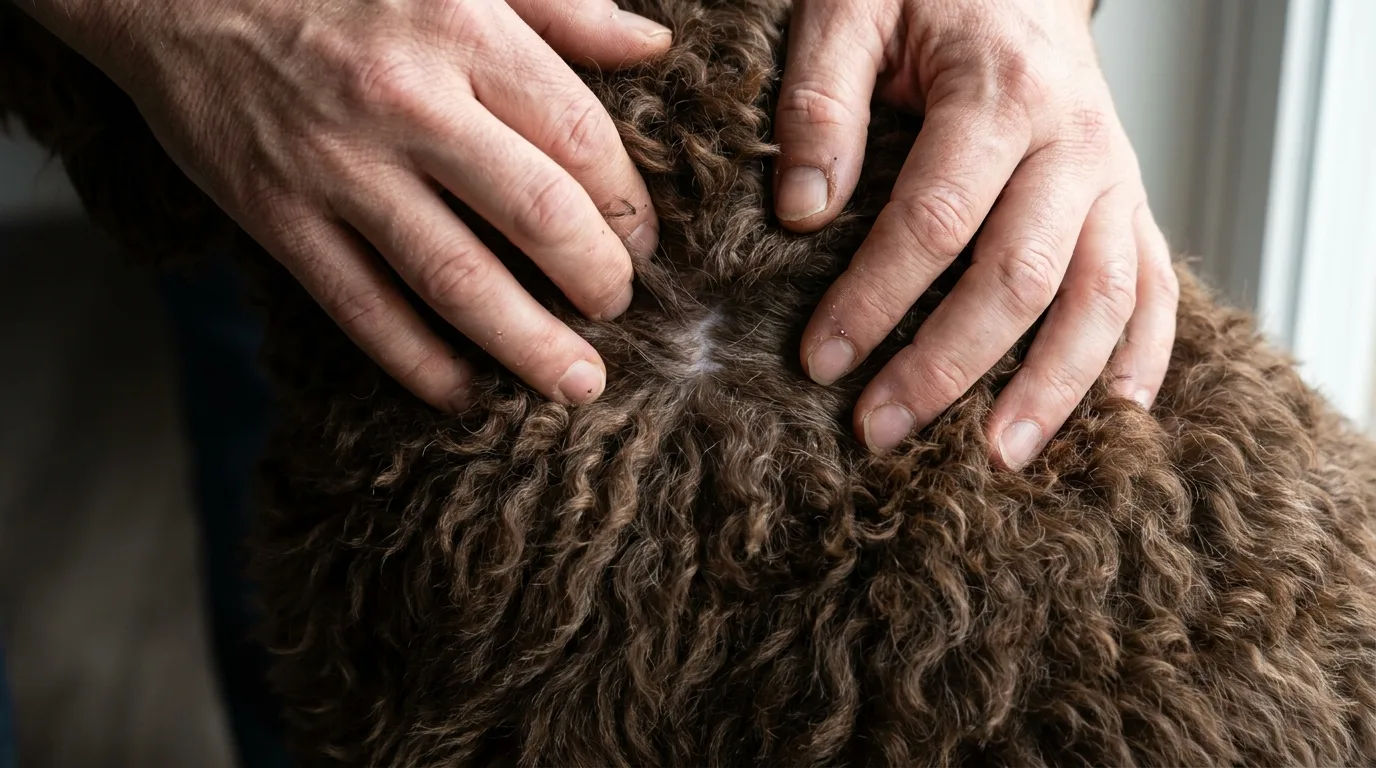
Usually, though the reason gets misunderstood. It is not that Australian Labradoodles are a low energy breed, because they are not. Temperament has been selected for across many generations, so the range is tighter and you are less likely to end up with the outlier who cannot settle.
Goldendoodles carry retriever drive from both parents, and in an F1 litter the intensity varies widely. One puppy settles at eight months and its littermate is still bouncing off the furniture at two years.
Both need real daily exercise, 60 minutes or more for the standard sizes with mental work on top. Neither is satisfied by a walk around the block.
Australian Labradoodle vs Goldendoodle Price
| Cost factor | Australian Labradoodle | Goldendoodle |
|---|---|---|
| What most buyers pay | $3,000 to $3,500 | $2,500 to $3,500 |
| Full range you will see | $2,500 to $4,000 | $2,000 to $5,000 |
| Cheapest realistically available | About $2,500 | About $2,000 |
| Waitlist | Often 6 to 18 months | Weeks to months |
| Health testing | Required by the registry | Required of GANA members only |
| Registration papers | ALAA or WALA | GANA, if the breeder is a member |
| Grooming every 6 to 8 weeks | $80 to $140 | $80 to $150 |
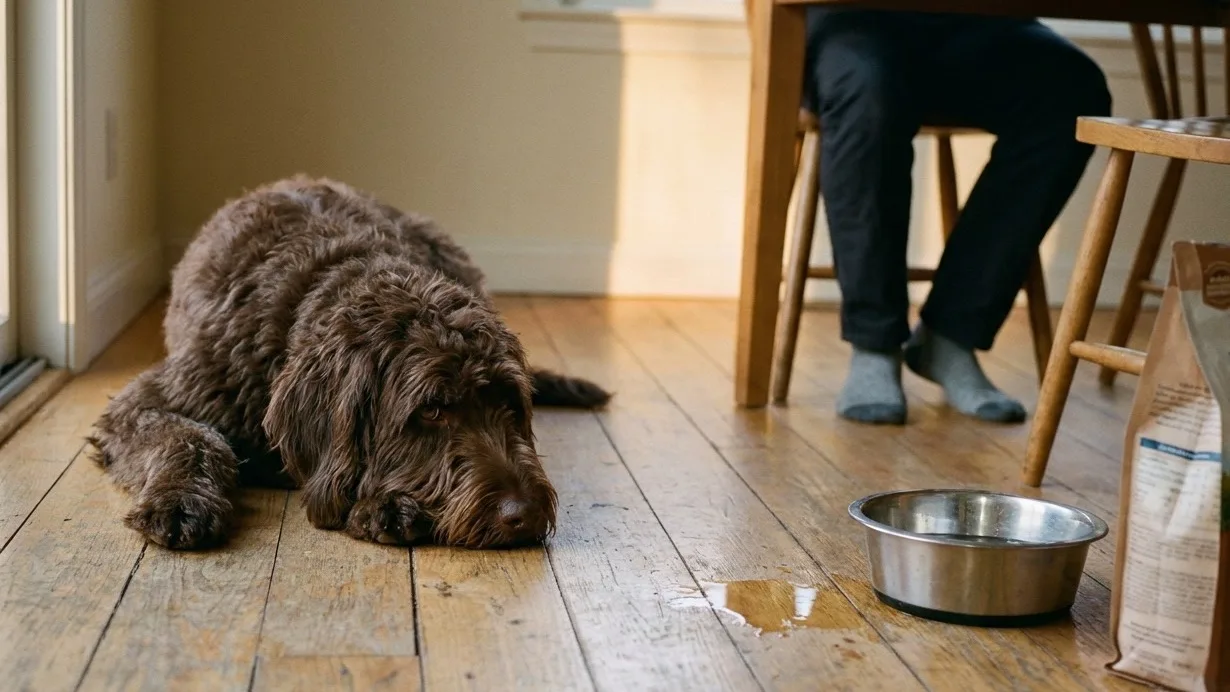
The Australian Labradoodle is not the more expensive dog at the top of the market. A Goldendoodle from a well known breeder can reach $5,000, higher than almost any Australian Labradoodle. What differs is the floor. Registry rules mean there is no cheap Australian Labradoodle, while the Goldendoodle market is far larger and much less regulated, so $2,000 puppies are easy to find. You are paying a higher minimum for a shorter list of unknowns rather than a higher price overall.
That minimum does not buy a healthier individual dog either. A well bred Goldendoodle from a GANA breeder with full clearances is a better bet than a poorly bred Australian Labradoodle with papers, because the papers describe the program rather than the puppy in front of you.
Is Either Breed AKC Recognized?
Neither. Both are crosses as far as the American Kennel Club is concerned, so neither can be registered or shown in conformation.
That bothers some buyers more than it should. AKC recognition governs pedigree sport. It is not a health certificate and not a quality mark, and a registered purebred from a careless breeder is still a badly bred dog. The testing on the two parents is what tells you something.
What Owners Complain About Most
With Australian Labradoodles it is availability and price. Year long waitlists are normal, deposits are usually non refundable, and the nearest registered breeder can be several states away. Buyers who will not wait often end up with a dog sold as Australian that turns out to be an ordinary Labradoodle.
With Goldendoodles it is variation. The adult comes out bigger than promised, or the coat sheds when the buyer was told it would not. Both trace back to vague generation labeling at the point of sale.
Owners of both underestimate the grooming. Neither is a wash and go dog, and the bill runs $600 to $1,300 a year for the life of the animal.
Frequently Asked Questions
Which One Should You Choose?
It comes down to how much uncertainty you are willing to take on.
- If you need a known coat, a known adult size and a known temperament, pay for the Australian Labradoodle and wait for the litter.
- If you want a large dog, choose the Goldendoodle. The Australian Labradoodle standard stops well below what a Standard Goldendoodle reaches.
- If budget is the constraint, a well tested Goldendoodle beats a poorly documented Australian Labradoodle every time. Papers are no substitute for clearances.
Either way, ask for the same three things: OFA hip and elbow results, a current eye certification, and DNA panels on both parents. A breeder who cannot produce them has answered the question for you.
If you are still comparing options, our guides on Labradoodle vs Goldendoodle and Cavapoo vs Goldendoodle cover the two closest alternatives.


