Goldendoodle Generations Explained: F1, F1B, F2, F2B & Multigen
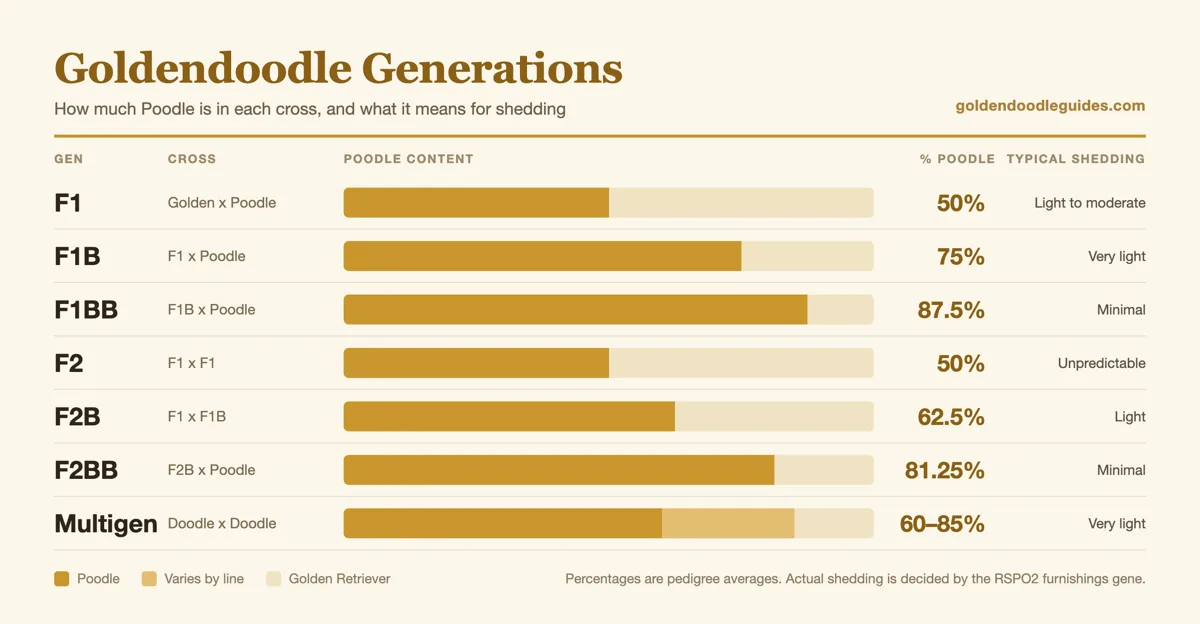
A Goldendoodle’s generation label tells you how much Poodle is in its pedigree. F1 is 50% Poodle, F1B is 75%, and F1BB is 87.5%. More Poodle usually means less shedding. But the label alone doesn’t guarantee it. One gene, RSPO2, is what actually decides.
Walk into any breeder’s waitlist conversation and you’ll hit the alphabet soup inside thirty seconds. F1. F1B. F2BB. Multigen.
Most buyers nod along and take whatever the breeder recommends. That is how people end up paying $3,200 for a “hypoallergenic” puppy that is leaving hair on the sofa by month four.
The labels are not marketing noise. They mean something specific, and once you understand the pattern you can read a pedigree in about ten seconds. They also have a hard limit that almost no guide explains, and that limit is the part that actually affects your carpet, your allergies and your grooming bill. We’ll get there in the second half.
What the F, the Number and the B Actually Mean
The system is borrowed from Mendelian genetics, which is why it looks more intimidating than it is.
F stands for “filial”, which is just the generation number. F1 is the first generation of the cross, F2 is the second, F3 is the third.
B stands for backcross. It means the doodle was bred back to one of the original purebred parent breeds. In Goldendoodles that is almost always the Poodle, because the Poodle is the side that brings the low-shedding coat.
So every extra B pushes the Poodle percentage up. F1B has one backcross. F1BB has two. That’s the whole system.
One thing worth saying early. These percentages describe ancestry on paper. They are an average of what a puppy is likely to inherit, not a measurement of what it actually did inherit. A litter of six F1B puppies does not contain six identical dogs. Hold that thought.
Goldendoodle Generations Chart: Poodle Percentage at a Glance
| Generation | Cross | % Poodle | % Golden Retriever | Coat predictability | Typical shedding |
|---|---|---|---|---|---|
| F1 | Golden Retriever x Poodle | 50% | 50% | Low | Light to moderate |
| F1B | F1 x Poodle | 75% | 25% | High | Very light |
| F1BB | F1B x Poodle | 87.5% | 12.5% | Very high | Minimal |
| F2 | F1 x F1 | 50% | 50% | Lowest | Unpredictable |
| F2B | F1 x F1B | 62.5% | 37.5% | Medium to high | Light |
| F2BB | F2B x Poodle | 81.25% | 18.75% | Very high | Minimal |
| Multigen (F3+) | Doodle x Doodle | 60 to 85% | 15 to 40% | Highest, if DNA-tested | Very light |
- F1 = 50% Poodle. F1B = 75%. F1BB = 87.5%. F2B = 62.5%. F2BB = 81.25%.
- Every “B” in the label means one more backcross to a purebred Poodle
- F2 has the same 50/50 split as F1 but produces the least predictable coats
- Shedding is controlled by the RSPO2 furnishings gene, not by the generation label
- A DNA-tested multigen is more predictable than an untested F1B, whatever the price tag says
F1 Goldendoodle: The Original 50/50 Cross
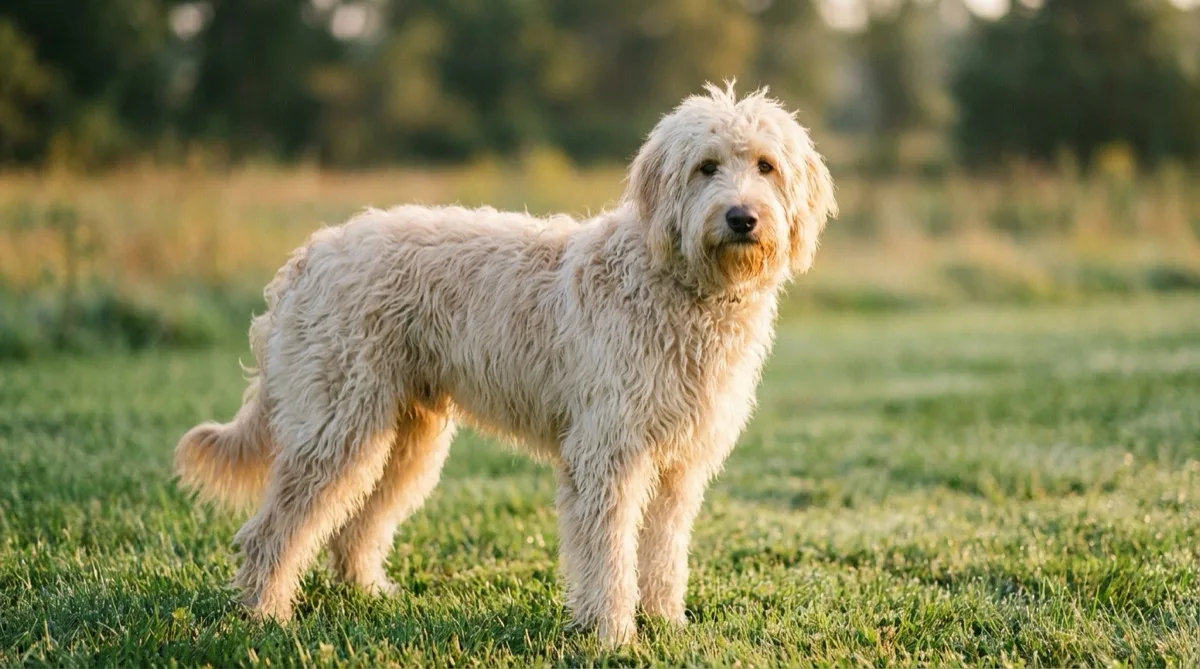
An F1 is the original recipe. One purebred Golden Retriever, one purebred Poodle. Nothing else in the mix.
What an F1 Coat Actually Looks Like
F1 coats are usually wavy. Breeders call it a “shaggy” or “fleece” coat. They shed lightly to moderately. Less than a Golden Retriever, noticeably more than a Poodle.
The honest version. F1 is the generation where you are least able to predict what you’re getting. Both parents are purebred, so each puppy inherits one coat gene from each side and the results scatter. Straight, wavy and curly can all show up in the same litter. Some F1s barely shed. Some leave enough hair to justify a second vacuum.
What People Like About F1s
Hybrid vigor is real, if modest. Crossing two unrelated purebred lines lowers the odds of the recessive conditions that concentrate inside a closed gene pool. It does not make a dog immune to anything. F1s still get hip dysplasia and they still get cancer. But the genetic diversity helps.
F1s also tend to be the most Golden-like in temperament. Softer, goofier, a bit more “velcro dog” and a bit less sharp than a heavily Poodle-weighted doodle. If you want the Golden personality with a lighter coat, this is the trade you’re making.
They’re often the cheapest too, typically $2,000 to $3,500 from a reputable breeder.
Who Should Get an F1
Families with no allergies in the house who want a friendly, sturdy dog and can live with some hair. If a single family member reacts to dogs, an F1 is a gamble.
F1B Goldendoodle: The One Breeders Push for Allergies
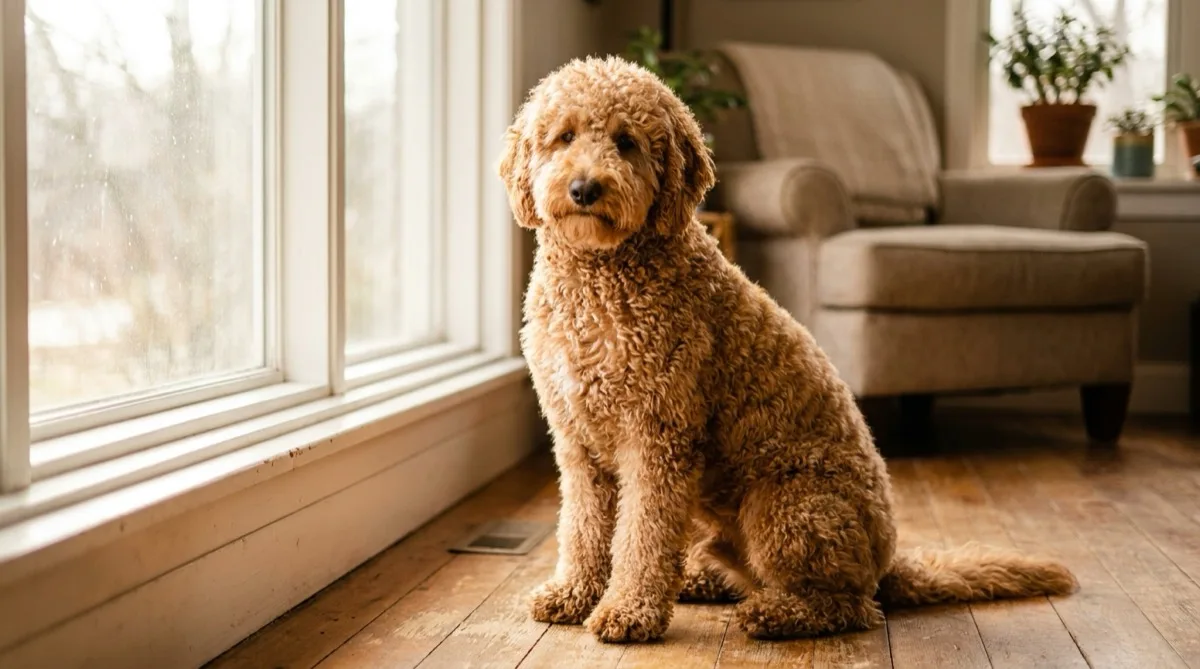
An F1B is an F1 Goldendoodle bred back to a purebred Poodle. Three quarters Poodle, one quarter Golden Retriever.
This is the generation most breeders push at allergy-conscious buyers, and the reasoning is sound. More Poodle genes means a higher chance of a curly, low-shedding, low-dander coat. We’ve broken this pairing down in detail in our F1 vs F1B Goldendoodle comparison, but the short version is that F1B coats are curlier and more consistent across a litter than F1 coats.
The Trade-Off Nobody Puts on the Sales Page
That curly coat sheds less because the loose hair stays trapped in the curl instead of falling out. It doesn’t disappear. It sits in the coat and tangles.
Which means mats. Which means grooming.
An F1B needs brushing three to four times a week at home and professional grooming every six to eight weeks. Expect $65 to $120 per session depending on your city and how matted the coat is when you walk in. Over a year that’s roughly $600 to $1,000, every year, for the life of the dog.
Skip the brushing for three weeks and the groomer will tell you the only humane option is a shave-down. That conversation happens more often than any breeder website admits.
Who Should Get an F1B
Mild allergy sufferers, and owners who genuinely will brush the dog. Not people who want a low-maintenance pet. An F1B is a low-shedding dog, and that is a completely different thing.
F1BB Goldendoodle: Almost a Poodle
Take an F1B and breed it back to a Poodle again. You get 87.5% Poodle and 12.5% Golden Retriever.
At this point you are, genetically speaking, close to a Poodle with a Golden accent. The coat is usually tightly curled and sheds minimally. Allergy families often do best here.
The trade is the same one, only steeper. Grooming demands go up, and the Golden Retriever softness that drew people to doodles in the first place starts to thin out. F1BBs are frequently more sensitive, more alert, and more mentally demanding than an F1. That is not a flaw. Poodles are brilliant dogs. It is just a different dog than the one many buyers picture.
F2 Goldendoodle: Same Percentages, Completely Different Litter
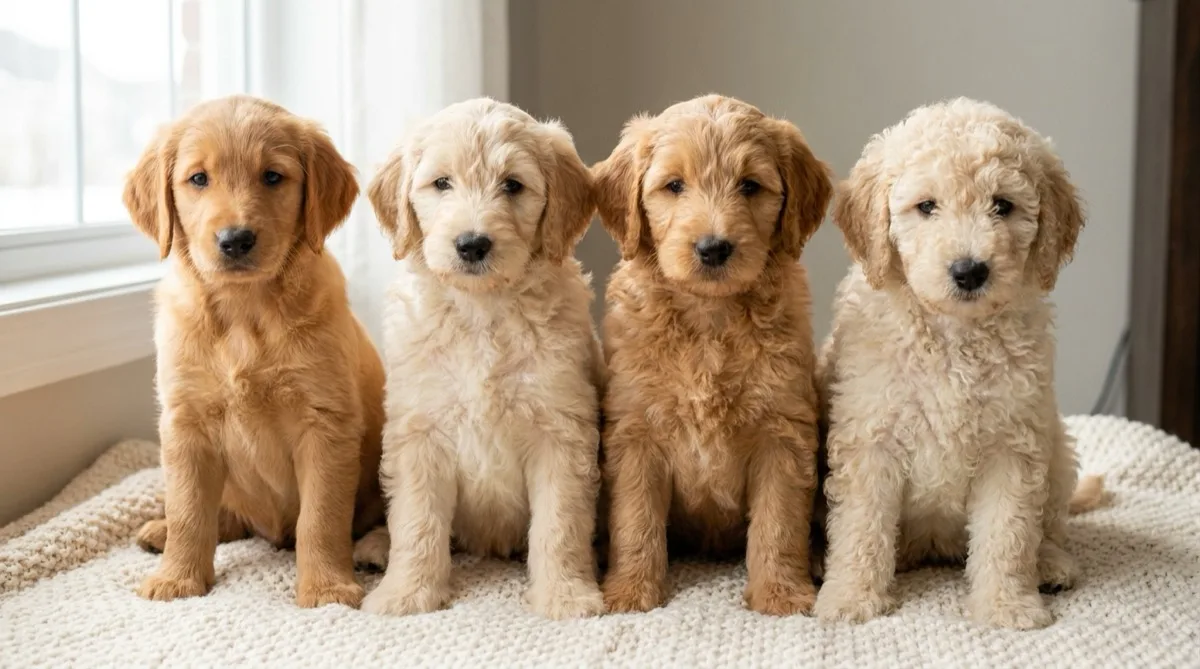
An F2 is two F1 Goldendoodles bred together. The percentages come out identical to an F1. Fifty percent Poodle, fifty percent Golden Retriever.
So why do F2 litters look nothing like F1 litters?
Why 50/50 Doesn’t Mean the Same as an F1
An F1 puppy gets exactly one set of coat genes from a purebred Golden and one from a purebred Poodle. Predictable inputs, semi-predictable output.
An F2 puppy gets its genes from two parents who are already mixed. Each parent can pass along either the Golden version or the Poodle version of every coat gene, and the combinations multiply. The result is the widest spread of any generation. One F2 litter can produce a flat-coated puppy that sheds like a Golden, a tight-curled puppy that looks like a Poodle, and four wavy puppies in between.
This is why experienced breeders often skip F2 entirely. The average is fine. The variance is the problem, and you are buying one puppy, not the average.
Who Should Get an F2
Buyers with no allergy concerns who are choosing a puppy in person, at eight weeks, when the coat is already showing. Never buy an F2 sight-unseen on a coat promise.
F2B and F2BB: The Middle Ground Nobody Talks About
An F2B is normally an F1 bred to an F1B, giving 62.5% Poodle and 37.5% Golden Retriever. Breed an F2B back to a Poodle and you get an F2BB at 81.25% Poodle.
F2B is an underrated middle ground. More coat predictability than an F1, more Golden Retriever character than an F1B, and grooming needs that sit between the two.
Two Breeders, Two Definitions of F2B
Here is something most generation guides get wrong, or quietly skip.
“F2B” is not used consistently across the industry. The standard definition is F1 bred to F1B, which works out to 62.5% Poodle. But some breeders use F2B to describe an F2 bred back to a Poodle, and that math gives 75% Poodle, not 62.5%.
Same label. Two different dogs. A 12.5 percentage-point gap in Poodle content, which is enough to change the coat.
So don’t accept the label on its own. Ask the breeder a plain question. “What were the two parents, and what generation was each of them?” A good breeder answers in one sentence without hesitating. A breeder who gets vague about it is telling you something.
Multigen Goldendoodle: What You Are Actually Paying For
Multigen means both parents are already Goldendoodles, usually F1B or later, bred over several generations. Poodle content typically lands somewhere between 60% and 85%.
On paper multigen looks like a muddle. In practice it is often the most predictable dog on this entire list, but only under one condition.
Multigen breeding lets a breeder select for specific traits across generations instead of rolling the dice on two purebreds. Coat type, size, temperament, health clearances. A serious multigen program running DNA tests can tell you, before the puppies are born, roughly what coats the litter will carry.
A multigen breeder who doesn’t test is just breeding doodles to doodles and charging extra for the word. That is the condition, and it matters more than the generation label.
Why the Generation Label Won’t Tell You If It Sheds
This is the section that should change how you shop.
Everything above describes ancestry percentages. Percentages are averages. What actually determines whether your dog sheds comes down to specific genes, and a puppy either inherits them or doesn’t, regardless of what the pedigree says.
RSPO2, the Furnishings Gene
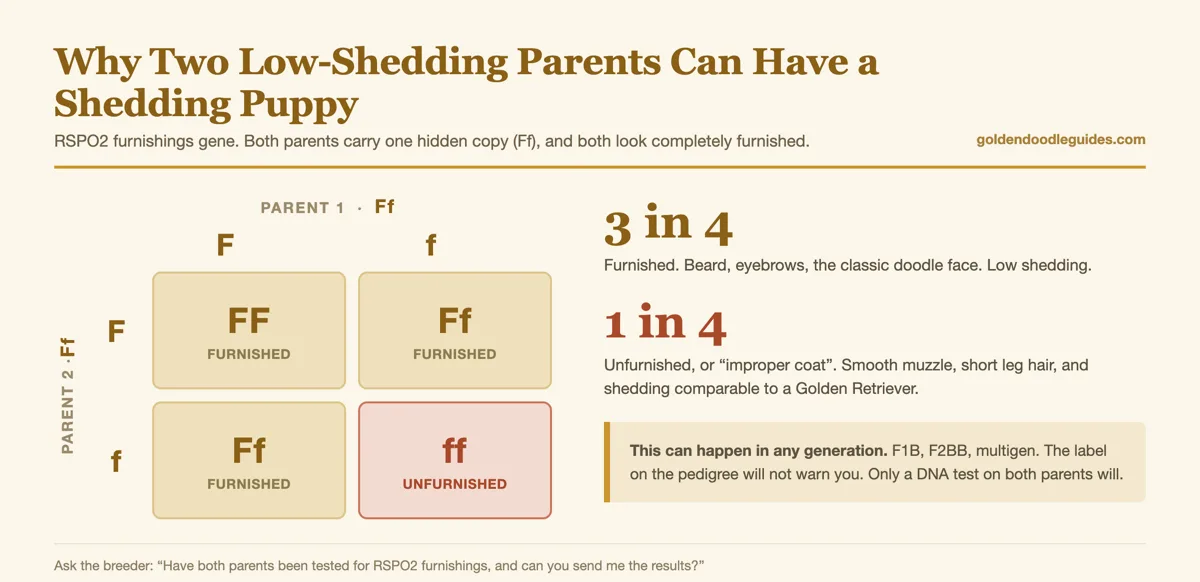
Furnishings are the doodle look. The beard, the moustache, the eyebrows, the longer hair on the face and legs. They’re controlled by a single gene called RSPO2, and the furnished version is dominant.
- FF: two copies. Furnished. Classic doodle face, low shedding.
- Ff: one copy. Furnished. Looks the same as FF.
- ff: no copies. Unfurnished. Short hair on the face and legs, a smooth muzzle, and shedding comparable to a Golden Retriever.
Breeders call the ff result an “improper coat”. The dog looks a bit like a slightly scruffy Golden Retriever rather than a doodle, and it sheds accordingly.
Now the important part. Two Ff parents can produce an ff puppy. Both parents look completely furnished. Statistically, one in four puppies in that litter will be unfurnished. That can happen in an F1B litter. It can happen in a multigen litter. The generation label will not warn you.
If shedding is the reason you’re buying a doodle at all, this is the single most important sentence in this guide.
KRT71, the Curl Gene, and Why It Isn’t the Same Thing
Curl is a separate gene, KRT71, tested by labs including the UC Davis Veterinary Genetics Laboratory. Two copies of a curl variant gives a curly coat, one copy gives wavy, none gives straight.
People assume curly means low-shedding. It’s an easy assumption and it’s wrong. KRT71 controls the shape of the hair. It has no bearing on how much of it falls out. An unfurnished dog with curl genes will still shed.
Curl matters enormously for your grooming bill. It does not decide your allergies.
The One Question to Ask Every Breeder
Memorize this and use it on the first call.
“Have both parents been tested for RSPO2 furnishings, and can you send me the results?”
Three things can happen.
A good breeder sends you a PDF, often within the hour, and may also send KRT71 curl results and health clearances without being asked. That’s the breeder you want.
Some breeders haven’t tested but say so honestly and explain what they’ve observed across past litters. That’s workable, if you’re flexible about coat.
And some get defensive, change the subject, or tell you the testing isn’t necessary because the puppies are F1B. Thank them and move on. The test costs a breeder well under $100 per dog and it is the entire basis of the promise they’re selling you.
The Health Questions That Matter More Than Generation
While you’re asking about coat genes, ask about health clearances. Generation has almost nothing to do with whether a dog stays healthy. Parent testing does.
For a Goldendoodle, both parents should have documented results for:
- Hips and elbows: OFA or PennHIP evaluation
- Heart: cardiac exam, ideally by a veterinary cardiologist
- Eyes: annual ophthalmologist exam, plus DNA testing for progressive retinal atrophy (prcd-PRA, GR-PRA1, GR-PRA2)
- Von Willebrand disease: a bleeding disorder carried on the Poodle side
- Ichthyosis: a skin condition carried on the Golden Retriever side
- Neonatal encephalopathy (NEwS): Poodle line
Organizations like the Goldendoodle Association of North America publish testing requirements for member breeders, which gives you a reference point even if your breeder isn’t a member.
A tested F1 from a careful breeder will almost always outlive an untested F1BB from a volume operation. The letters on the pedigree are the least useful predictor of health on this page.
Which Goldendoodle Generation Is Right for You?
If Someone in the House Has Mild Allergies
F1B, F1BB, or a DNA-tested multigen. Insist on seeing furnishings results. Then spend an hour in the same room as the actual parent dogs before you commit. Allergy responses are individual, and no lab result replaces that hour.
If It’s Your First Dog
F1 or F2B. Both lean a little more Golden Retriever in temperament. Softer, more forgiving of training mistakes, less likely to outsmart you at nine months old.
If Your Grooming Budget Is Tight
F1, straight-coated or wavy. Curlier generations cost $600 to $1,000 a year in professional grooming and that number doesn’t go down. Choosing an F1B to avoid vacuuming and then finding you can’t afford the groomer is a genuinely common mistake, and it’s the dog that pays for it in shave-downs.
If Predictability Is What You’re Paying For
A multigen from a breeder who DNA-tests and can show you the paperwork. Expect $3,000 to $5,000. You are paying for the testing program, not the label.
If You Are Still Deciding Between Breeds
Worth reading our comparisons of Goldendoodle vs Golden Retriever, Labradoodle vs Goldendoodle and Bernedoodle vs Goldendoodle before you put down a deposit. If predictability is what you are after, Australian Labradoodle vs Goldendoodle is the one to read, and Cavapoo vs Goldendoodle covers the smaller end.
Four Myths That Cost Buyers Money
“F1B Goldendoodles are hypoallergenic.” No dog is hypoallergenic. F1Bs shed less dander, which helps many allergy sufferers. It is a reduction in exposure, not an elimination, and a meaningful number of people still react.
“Higher generation means healthier.” There’s no such rule. Hybrid vigor is strongest at F1 and dilutes as lines close up again. Health comes from parent testing, not from the letter on the pedigree.
“Curly coats don’t shed.” Curly coats trap shed hair instead of dropping it. The hair still comes out of the follicle. It just ends up as a mat instead of on your sofa.
“Multigen is always better.” Only when the breeder is selecting with data. Without DNA testing, multigen is a marketing word with a price increase attached.
Frequently Asked Questions
What to Do Before You Pay a Deposit
Generation labels are useful. They tell you the likely Poodle percentage, and Poodle percentage shifts the odds on coat, shedding and grooming. Learn the pattern and you can read any breeder’s listing at a glance.
But they’re odds, not guarantees, and the dog you bring home is one puppy, not an average. Two things beat the label every time. RSPO2 furnishings results for both parents, and documented health clearances.
Get those two and the letters on the pedigree stop mattering very much. That is the actual shortcut.
Comparing specific generations side by side? Start with our F1 vs F1B breakdown, or browse the full comparison guides.
